

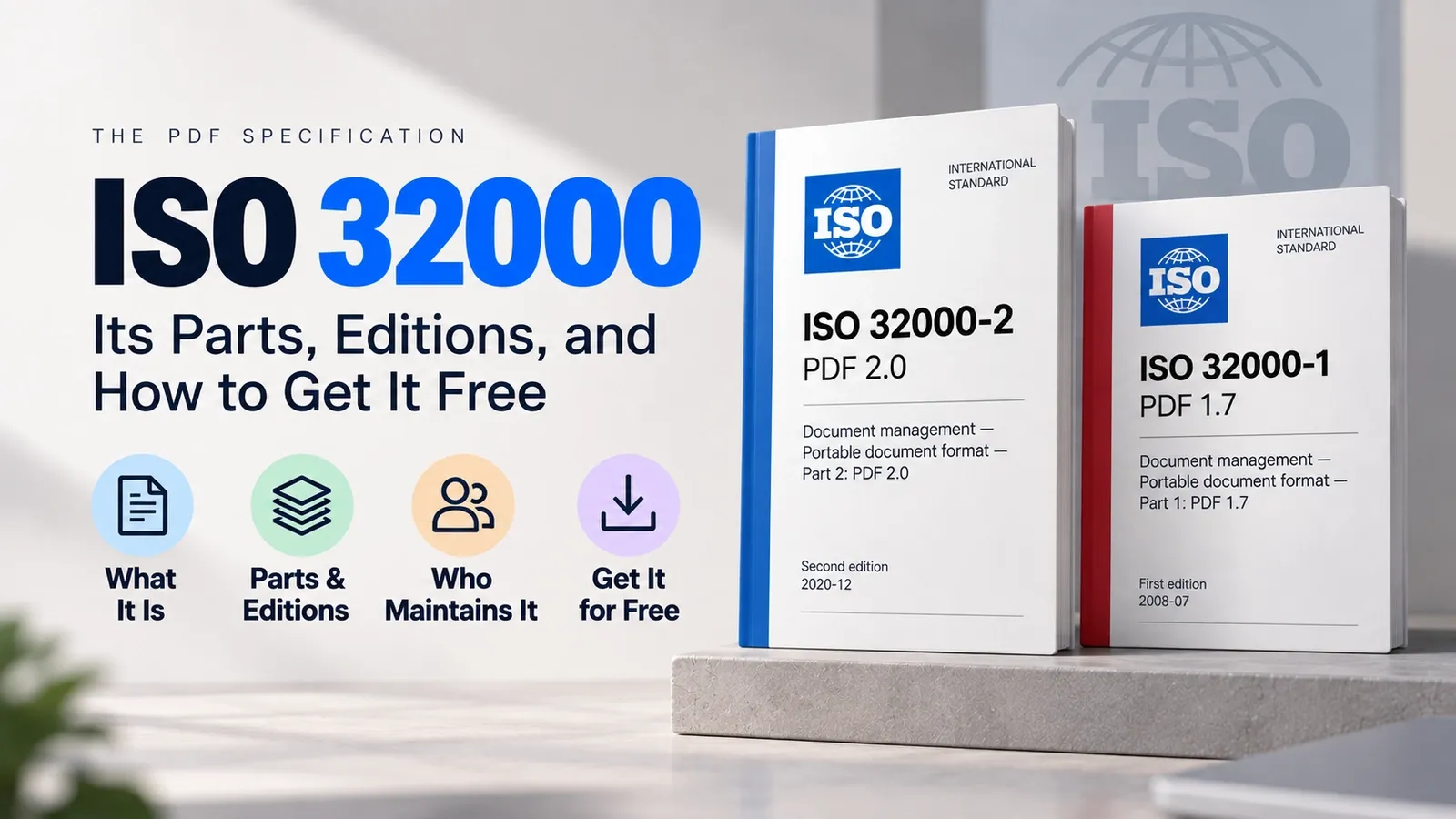
ISO 32000 is the official PDF specification that defines how PDF files are structured, written, read, and interpreted by compliant tools. It is the international standard behind modern PDF, and you can read ISO 32000-2 for free through the PDF Association.
This article treats ISO 32000 as a document, not just a technical name. That means looking at its parts, its edition history, who maintains it, how it connects to Adobe’s older PDF Reference, and where readers can get the specification without paying ISO catalogue prices.
First, we will explain what ISO 32000 is and why it works as the PDF rulebook. Then we will explain how Adobe’s PDF Reference became an ISO document, what ISO 32000-1 standardised, and how ISO 32000-2 turned PDF 2.0 into the first fully ISO-authored edition.
After that, the article covers who maintains the standard, how Adobe’s historical PDF Reference relates to today’s ISO specification, what PDF 2.0 deprecated, and how to get the ISO 32000 specification, including the free PDF Association route.
The main point is simple: ISO 32000 is the rulebook for PDF, and ISO 32000-2 is available as a free sponsored standard through the PDF Association, even though the ISO catalogue itself usually points readers toward paid access.
What Is ISO 32000?
ISO 32000 is the international standard that formally defines the PDF file format. It is the PDF specification that every compliant PDF reader, editor, converter, validator, and processor is expected to follow.
Think of ISO 32000 as the official PDF rulebook. It tells software how a PDF file should be built, how its parts should be interpreted, and how the document should behave when opened or processed.
The specification does not only describe what a PDF looks like on screen. It governs the file structure behind it, including objects, streams, dictionaries, operators, fonts, images, metadata, annotations, graphics, text handling, and other technical pieces that make a PDF work.
ISO 32000 has two main parts. ISO 32000-1 standardised PDF 1.7, while ISO 32000-2 defines PDF 2.0. Together, they explain the core PDF format that other PDF standards and subtypes build on.
So when people refer to ISO 32000, they are talking about the authority behind the PDF format itself, not a separate kind of PDF file.
How Did the PDF Specification Become ISO 32000?
Adobe’s published PDF Reference 1.7 was submitted to ISO and republished as ISO 32000-1 in 2008. That is how the PDF specification moved from an Adobe reference document into the ISO standards system.
Before ISO 32000, Adobe’s PDF Reference was the main technical document for the PDF format. It explained how PDF files were structured, how objects and features worked, and how software should interpret the format.
The important specification lineage is that PDF Reference 1.7 became ISO 32000-1 almost word for word. ISO did not create a completely new PDF format in 2008; it standardised the already published PDF 1.7 specification as an international document.
This section is only about the document line from Adobe PDF Reference to ISO standard. The ownership question — why Adobe handed the PDF specification to ISO and who owns the PDF format now — belongs in the separate who-owns-PDF guide.
So the simple answer is this: PDF Reference 1.7 became ISO 32000-1, and that made PDF 1.7 the formal baseline specification for compliant PDF tools.
What Is ISO 32000-1 (PDF 1.7)?
ISO 32000-1 is part 1 of ISO 32000, published in 2008, that standardised PDF 1.7 as the baseline specification for compliant PDF tools.
This part defines PDF at the specification level. It explains the file syntax, objects, streams, dictionaries, operators, graphics model, text handling, fonts, annotations, metadata, encryption rules, and other core pieces that software needs to read and process PDF 1.7 correctly.
The important distinction is that PDF 1.7 is the version of the format, while ISO 32000-1 is the rulebook that formalised that version as an international standard. One is the feature set; the other is the standards document that defines how that feature set should work.
So this section is not trying to list every PDF 1.7 feature. The feature-by-feature changes across PDF versions belong in the PDF version history guide. ISO 32000-1 matters because it became the first ISO baseline for the PDF format and the starting point for how modern PDF specifications are discussed.
What Is ISO 32000-2 (PDF 2.0)?
ISO 32000-2 is the second part of ISO 32000, published in 2017 and revised in the 2020 edition, that defines PDF 2.0 as the first fully ISO-authored PDF specification.
Unlike ISO 32000-1, which came from Adobe’s PDF Reference 1.7, ISO 32000-2 was written through the ISO standards process. That makes it a governance milestone, not just another PDF version update.
At the specification level, ISO 32000-2 cleaned up the PDF rulebook. It clarified existing behaviour, removed Adobe-proprietary content, updated technical requirements, and moved the format toward a cleaner vendor-neutral standard.
PDF 2.0 is the version of the format, while ISO 32000-2 is the standards document that defines that version. The detailed PDF 2.0 feature changes belong in the PDF version history guide.
Here, the main point is that ISO 32000-2 moved the PDF specification from an Adobe-derived document to a fully ISO-authored edition with no Adobe-proprietary content.
Who Maintains ISO 32000?
ISO 32000 is maintained by ISO TC 171, SC 2, with the PDF Association serving as the committee manager for that PDF standards work.
This means the PDF specification is not updated casually by one software company. Changes move through the ISO standards process, where the responsible technical committee reviews updates, corrections, and future standardisation work.
The maintenance work can include clarifying unclear parts of the specification, publishing errata, correcting technical issues, and developing new parts or updates when the PDF standard needs to evolve.
This is separate from the ownership question. The maintenance body edits and manages the standard through ISO, while the broader question of who owns the PDF format belongs in the separate who-owns-PDF guide.
The important point is that ISO 32000 is maintained through ISO TC 171 SC 2, not through Adobe alone. The PDF Association’s committee-manager role helps coordinate that standards work inside the ISO process.
How Do the Adobe PDF Reference and ISO Specs Relate?
The old Adobe PDF Reference and today’s ISO 32000 describe the same PDF format, but ISO 32000 is now the authority. ISO 32000-1 was based directly on Adobe’s PDF Reference for PDF 1.7.
Before ISO standardisation, Adobe’s reference documents explained how PDF worked. Developers used those documents to understand file structure, objects, graphics, fonts, annotations, forms, and other PDF features.
ISO 32000 changed the authority path. Adobe’s PDF Reference 1.7 became the base for ISO 32000-1, and the ISO standard now supersedes the old Adobe document for formal citation and implementation.
That means Adobe’s PDF Reference is now historical. It still helps explain where the specification came from, but it should not be treated as the current rulebook for modern PDF compliance.
For current standards work, cite ISO 32000 instead of the old Adobe PDF Reference. The Adobe document explains the past; the ISO specification defines the present standard.
Which Extensions Were Deprecated in PDF 2.0?
ISO 32000-2 deprecated Adobe-proprietary additions such as XFA forms and older weak encryption in PDF 2.0, moving the format toward standardised replacements and a cleaner vendor-neutral specification.
Before PDF 2.0, some PDF features came through Adobe extension levels. These additions helped Adobe and other tools support newer behaviour before the ISO standard fully caught up, but they also made the format harder to treat as one clean international specification.
PDF 2.0 cleaned that up by moving away from proprietary or fragile features. XFA forms are a key example because they came from Adobe’s form technology rather than the core ISO PDF model. Older weak encryption methods were also deprecated because long-term PDF tools should not rely on outdated security mechanisms.
The reason is not only technical cleanup. A standard should be predictable for implementers. If PDF software depends on Adobe-specific extensions, non-standard forms, or weak legacy encryption, the file may be harder to validate, preserve, process, or support consistently across vendors.
So the practical rule is simple. In a PDF 2.0 world, do not build workflows around XFA, weak encryption, or old extension-level behaviour. Use the standardised PDF features.
How Do You Get the ISO 32000 Specification, Including Free?
You can buy ISO 32000 through the ISO catalogue, but ISO 32000-2 is also available as a free download through the PDF Association sponsored standards page.
The paid ISO route is the formal catalogue route. If you search ISO’s catalogue for ISO 32000, you will usually find the official standard listing, edition information, and purchase options for the specification.
The free route is the one many readers miss. The PDF Association hosts ISO 32000-2 as a sponsored standard, which means you can access the PDF 2.0 specification at no cost from its sponsored-standards page.
These routes do not always feel obvious because the ISO catalogue normally presents standards as paid documents. The PDF Association route matters because it gives implementers, developers, researchers, and PDF tool builders a legal way to read the current PDF specification without paying for ISO access.
When downloading, check that the title and edition match what you need. If you need the modern PDF 2.0 specification, ISO 32000-2 is the key document to look for.
Which Standards Are Built on ISO 32000?
The main PDF subtypes built on the ISO 32000 core are PDF/A, PDF/X, and PDF/UA. They are separate ISO standards, but each subtype constrains the base PDF rules for a specific purpose.
In one line: PDF/A narrows PDF for archiving, PDF/X narrows PDF for print production, and PDF/UA narrows PDF for accessibility.
The full side-by-side explanation belongs in the dedicated comparison guide, not here. For the detailed breakdown, read PDF/A vs PDF/X vs PDF/UA.
How Do PDF Versions Map to ISO 32000?
PDF 1.7 maps to ISO 32000-1, and PDF 2.0 maps to ISO 32000-2. That is the main version mapping readers need when connecting PDF versions to the ISO 32000 standard.
The simple way to understand it is that ISO 32000-1 standardised PDF 1.7, while ISO 32000-2 defines PDF 2.0. These are the two major version-to-standard links inside the ISO 32000 family.
This section only covers the mapping between PDF versions and ISO parts. The feature-by-feature history of older PDF releases, version changes, and format updates belongs in the dedicated PDF version history guide.