



Rotate PDF Pages Online and Save the Rotation
Turn a sideways or upside-down page the right way up, and keep it that way. The angle is written into the file, not into your window, so your recipient sees what you see. Rotating happens in your browser. No sign-up, no watermark.
- Free PDF rotate tool. No account, no watermark.
- Rotate one page, several, or the whole file. Each turn is a quarter, so two make a half.
- Runs in your browser on any device. Your file is never uploaded.

or drop your PDF here
Any PDF your device can comfortably open · 90, 180 or 270 degrees · Free
Your file is rotated in your browser. It is never uploaded to our servers, and nothing is stored.

Nothing Is Uploaded
Rotation runs in your browser. The file never crosses the network.

The Rotation Is Saved
The angle goes into the page itself, so every viewer shows it the same way.

No Sign-Up, No Watermark
Free. No trial, no email gate, and nothing stamped on your output.

No Quality Loss
Rotating sets a page value. Nothing is re-encoded.
How to Rotate a PDF Online
Three steps to rotate PDF and save the result. No installs, no accounts, no upload.
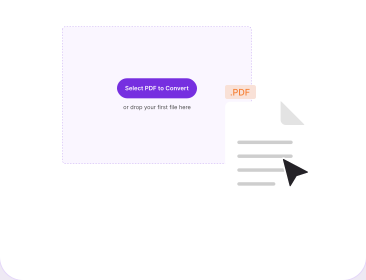
Open Your PDF
Drag the file into the box above or pick it from your device. Thumbnails show you which pages are the wrong way up.
Rotate the Pages You Need
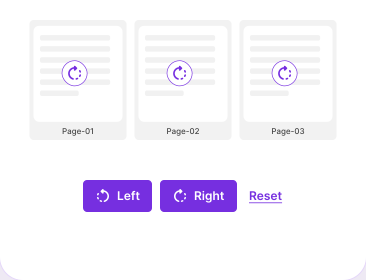
Use Left or Right to turn one page, a selection, or the whole document. Each click is a quarter turn, so two clicks right a page that came out upside down, and different pages can end up at different angles.
Download the Rotated PDF
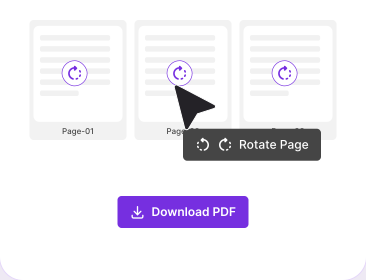
Click Rotate and save the file. That is what permanently rotates the PDF: the angle is stored in the document itself, so it opens correctly for everyone who receives it.
Why Rotate a PDF With PDFNoob?
The rotation goes into the file, and the file stays on your device.

The Rotation Goes Into the File
Not a view setting. The angle is stored in the page's own rotation property, so the document opens the same way up for you, your printer and your recipient.

The File Stays on Your Device
Rotation runs in a worker inside your browser, so the document never crosses the network. Once this page has loaded it works on a flaky connection, and a passport scan never leaves your machine.

A Quarter Turn at a Time
Left and Right turn the page a quarter at a time, and the thumbnail updates with every click, so you can see you have it right before you save.

Some Pages, Not All of Them
Mixed files are the common case. Fix the landscape scans in the middle of a portrait report and leave the rest as they were.

Text, Scans and Annotations Survive
Rotating changes a page property rather than re-drawing it, so text stays selectable, scans stay sharp and annotations stay put.

Free, With No Account
Rotate PDF free: no account, no trial, no email gate, and no branding on your output.
About Rotating PDF Pages
Rotation is the smallest edit a PDF can carry and it causes more confusion than anything else of its size. A scan comes out sideways, or a merged file has one source lying on its side. Fixing it takes a second, and whether it lasts depends entirely on where you did it: a PDF page carries a rotation value, and only a saved rotation changes it.
Why a Rotation in Your Viewer Disappears
Most people meet rotation inside a viewer rather than an editor: Chrome's built-in PDF viewer has a rotate control in its toolbar, macOS Preview has one, and Acrobat Reader keeps Rotate View in its View menu. The keyboard shortcuts Chrome and Acrobat Reader offer rotate the view too. All of them change how the page is drawn for that session and leave the file untouched, so reopening the document brings the sideways version back.
A saved rotation is a different operation. The angle is written into the page's own rotation property inside the PDF, so it belongs to the document rather than to your window, and every viewer on every device reads it. That is why it survives being reopened, emailed, printed or merged, and why a page can look upright to you and sideways to your recipient.
One viewer is the exception: macOS Preview's rotate button changes the document, not just the display, so rotate, then save, and the angle stays. Chrome's viewer cannot write a rotation into the file at all, whatever you do with its download button. To tell which kind of rotation you just did, close the file and reopen it. That is also the test for how to permanently rotate PDF pages: a rotation that survives a reopen is the one that stuck.
Rotating Some Pages and Not Others
Turning a whole document is the easy case. The one that needs help is a mixed document: eight portrait pages followed by four charts that were scanned in landscape, or a merged file where one source came in on its side. Rotate all of it by the same amount and you fix half the file while breaking the half that was already fine. Being able to rotate pages in a PDF one at a time, rather than the whole document at once, is what makes a mixed file straightforward.
How to rotate PDF pages by the right amount depends on how the text runs:
- 90 degrees is a quarter turn clockwise, for text that currently reads bottom to top.
- 270 degrees is the same quarter turn the other way, for text that reads top to bottom.
- 180 degrees is a half turn, for a page that went through the scanner upside down.
If you cannot tell 90 from 270 by eye, pick one and look at the result. Rotations add up, so if your first guess lands the page upside down, another 180 finishes the job. Rotation only fixes orientation: PDF Editor rearranges pages that are in the wrong order, and Unlock PDF handles a file that will not open without a password.
Related PDF Tools
Other tools you might need today.


Frequently Asked Questions
Rotating PDF pages, and making the rotation stick.
Why Did My Rotation Disappear When I Reopened the File?
You rotated the view, not the file. Chrome's built-in viewer and Acrobat Reader's Rotate View change how the page is drawn for that session, so the original orientation returns when you reopen it. Rotating here writes the angle into the page instead.
Can I Rotate Just One Page of a PDF?
Yes. Every page appears as a thumbnail and rotates on its own, so you can turn one sideways scan in the middle of a long report and leave the rest alone. You can also select several pages, or rotate the whole file at once.
What Is the Difference Between Rotating 90, 180 and 270 Degrees?
90 degrees is a quarter turn clockwise and 270 degrees is a quarter turn the other way, so those two fix a sideways page. 180 degrees is a half turn, for a page scanned upside down. None of the three is a flip: rotating turns the page, while flipping mirrors it, which reverses any text.
Can I Rotate Pages in Different Directions in the Same File?
Yes. Each page keeps its own angle, so page 3 can go 90 degrees and page 7 can go 270 degrees in the same pass. That is what a mixed document needs.
How Do I Rotate a PDF on a Mac?
macOS Preview is one of the few viewers whose rotate button changes the document rather than only the display: rotate, then save, and the angle stays in the file. Preview rotates the whole document at once, so use the tool above when only some pages are the wrong way up.
Does Rotating a PDF Reduce the Quality or Change the File Size?
No. Rotating sets a rotation value rather than re-encoding the page, so text stays selectable, a scan is as sharp as before, and annotations stay attached. File size barely moves. For a smaller file, use Compress PDF.
Does My File Get Uploaded Anywhere?
No. The rotation runs inside your browser, so the document never crosses the network and nothing is stored on our side. One consequence: once this page has loaded, rotating works even if your connection drops.
Can I Rotate a Password Protected PDF?
The open password has to come off first: a PDF that will not display without a password cannot be read by any tool, including this one. Take it off with Unlock PDF, then rotate. A file that only restricts printing usually rotates fine.