

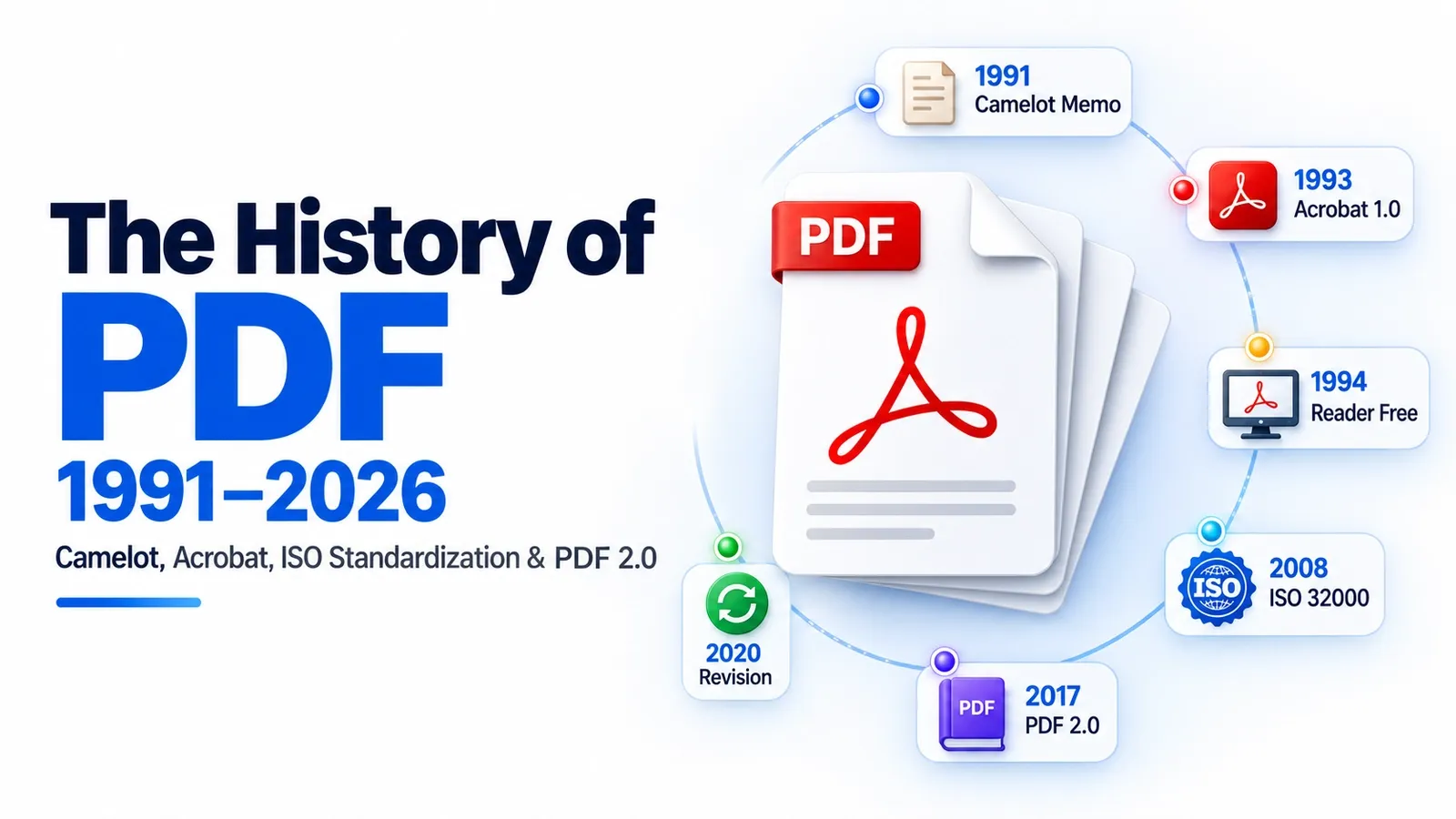
PDF began as a 1991 Adobe memo and grew into the fixed-layout standard now used to preserve document appearance across computers, printers, operating systems, and software.
The dated spine of PDF history runs through a few major moments: the 1991 Camelot memo by John Warnock, the internal Adobe code name Carousel, the launch of Acrobat 1.0 in 1993, the free Acrobat Reader decision in 1994, the move to ISO 32000 in 2008, and the later arrival of PDF 2.0 in 2017 with a 2020 revision.
PDF did not appear from nowhere. It grew from PostScript, Adobe’s page-description technology for reliable printing, and turned into a portable document format that could preserve layout, fonts, graphics, links, forms, signatures, and final page appearance across different systems.
This guide covers the full evolution of PDF, beginning with the need for a document format that could look the same across different computers and printers. It explains how PostScript shaped the idea, how the Camelot project turned it into a practical proposal, and how Acrobat introduced PDF to the public. It also follows the role of the free Adobe Reader in wider adoption, the major features added from PDF 1.0 through 1.7, the transition to an open standard, the arrival of PDF 2.0, and the development of specialized subsets such as PDF/A and PDF/X. Along the way, it also explains why PDF has remained relevant and who governs the format today.
Why Was the PDF Format Needed?
In the early 1990s, the same document could look and print differently on every machine, so Adobe needed a universal document format that could keep the page stable wherever it opened.
A file might lose its layout because of missing fonts, different software versions, or a printer driver that handled color and spacing differently. Even when the document looked correct on one computer, it could shift, reflow, or print with unexpected changes on another system.
PDF was created to protect a fixed layout in a self-contained file. The goal was simple: what you see on screen should match what you print, and the file should not depend completely on the original app, operating system, or printer setup.
Adobe already had PostScript for reliable printing, but the bigger need was a cross-platform document people could view, share, archive, and print without rebuilding the page each time. PDF became a form of electronic paper: portable enough to move between systems, but stable enough to preserve print fidelity long after the original software changed.
How Did PDF Evolve From PostScript?
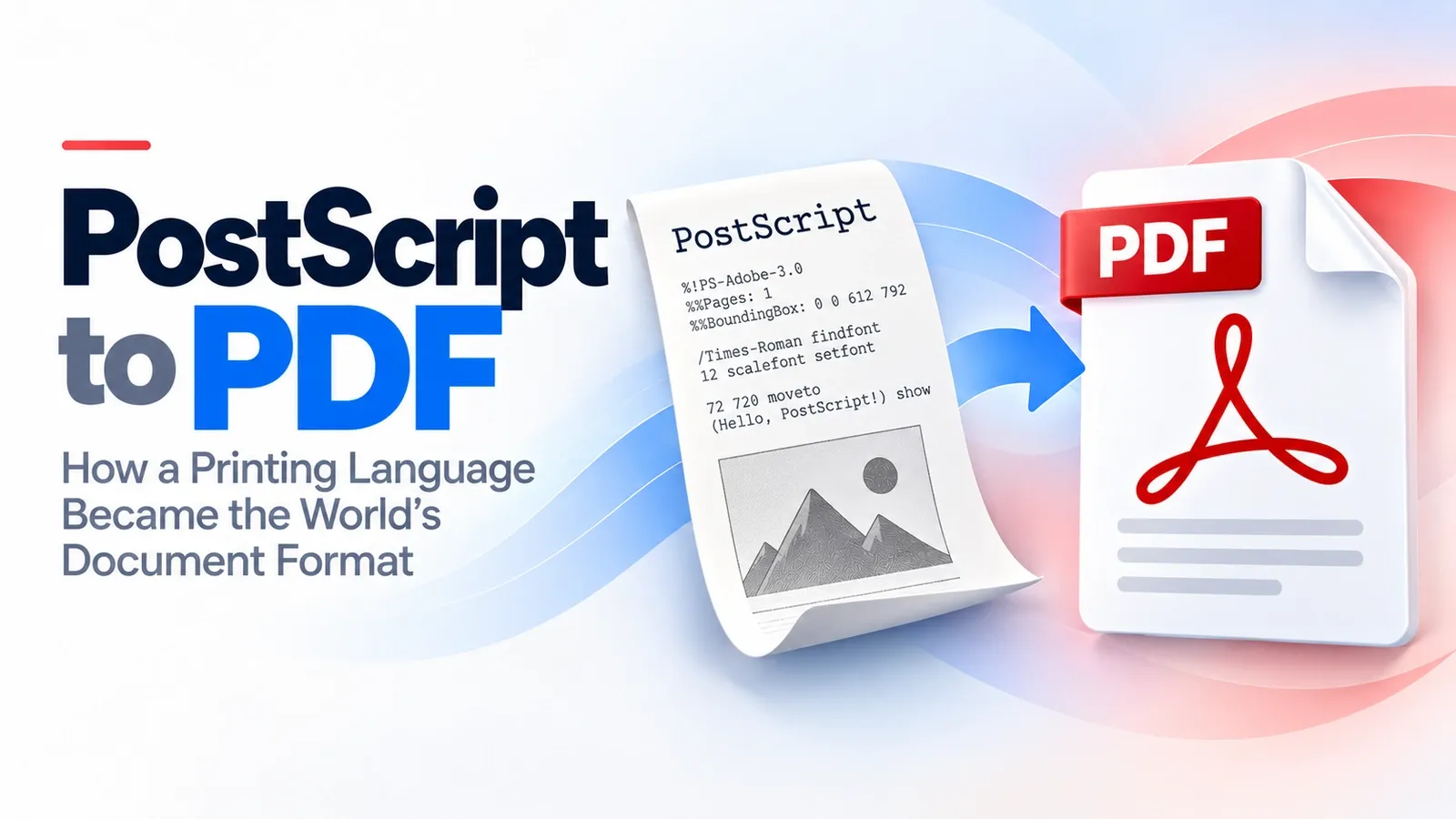
PDF grew out of PostScript, Adobe’s page-description language, but it was redesigned for document exchange instead of direct printing. PostScript told printers how to draw a page, while PDF turned that page description into a portable file people could open, share, search, and store.
PostScript was powerful for professional printing, but it was not ideal as a general sharing format. It could depend on printer interpretation, process pages like a program, and require more technical handling than everyday document exchange needed.
PDF kept the useful parts: device-independent page rendering, stable layout, embedded resources, and embedded fonts. It dropped the full programming-language layer of PostScript, which made PDF more predictable for viewing and exchange.
That is the important technical shift: PDF became a simplified subset with random access, so a viewer could jump to a page without running the whole file like a program from beginning to end. This made PDF easier to display consistently across systems.
The early idea was connected to Interchange PostScript, a name that shows how closely PDF’s roots were tied to PostScript. Distiller then became the bridge between the two: it converted PostScript output into PDF files, helping print-ready page descriptions become portable digital documents.
What Was the Camelot Project?
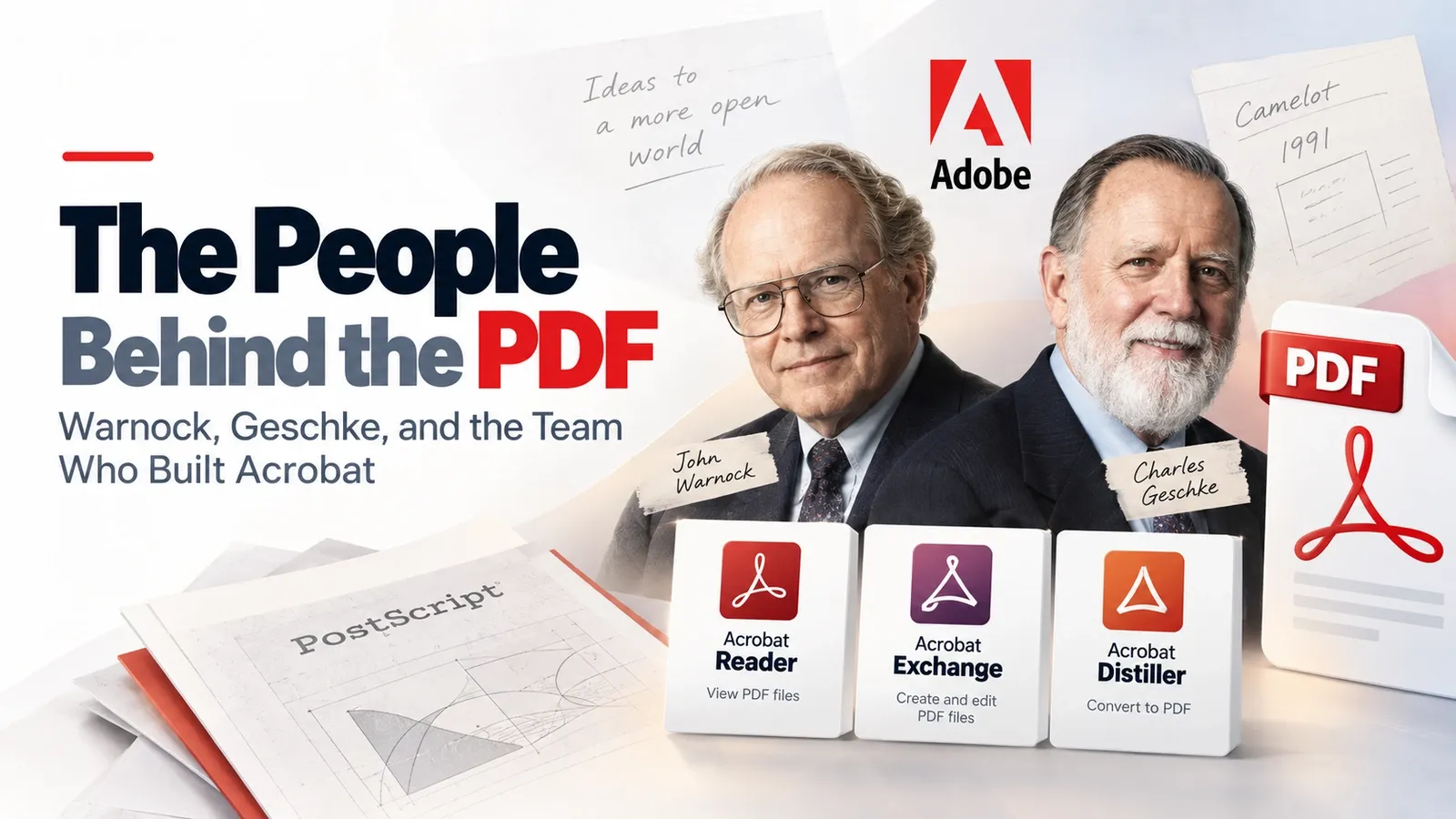
Camelot was the 1991 Adobe initiative, described in an internal memo by Adobe co-founder John Warnock, that proposed a way to capture a document and reproduce it reliably on any machine.
Warnock’s practical goal was to let people “view and print any document anywhere,” even if they did not have the original software, fonts, printer setup, or computer system that created the file. That idea matched the larger need for a universal document that could travel without losing its page appearance.
The format was first pitched as Interchange PostScript, or IPS, which reflected its roots in PostScript. Inside Adobe, the work also ran under the code name Carousel, a detail often left out when the PDF origin story is reduced to only the Camelot memo.
When Did the Acrobat Launch Introduce the PDF?
Adobe introduced the PDF publicly when it released Acrobat 1.0 on June 15 1993. This was the point where the internal document-sharing idea became a real product for creating, viewing, and exchanging fixed digital pages.
The first Acrobat release had three main parts. Acrobat Reader was for opening and viewing PDF files, Acrobat Exchange was for working with and editing PDF documents, and Acrobat Distiller converted PostScript output into PDF.
With PDF 1.0, Adobe established the core fixed layout page model that made PDF useful: the file could preserve page appearance, fonts, graphics, and hyperlinks more reliably across different systems.
The launch did not make PDF universal overnight. Early reception was cautious because the format was new, the workflow was unfamiliar, and people still needed the right Acrobat tools before PDF could become a normal way to share finished documents.
Why Was Acrobat Reader Made Free?
Acrobat Reader was made free because charging people just to open PDFs slowed the format’s adoption. With Acrobat 2.0 in 1994, Adobe turned Reader into a free viewer, removing one of the biggest barriers between a PDF file and the person who needed to read it.
A paid viewer created friction. If someone received a PDF but did not already own Reader, the file was harder to share than a document that could be opened immediately. Making the viewer free made the PDF feel more practical for everyday exchange.
Free Reader also worked like a distribution engine. It could be bundled with PDF files, offered through software discs, installed in offices, and used as a browser plugin, so every shared PDF helped push more people toward the viewer.
That decision helped PDF move from an Adobe product workflow into a de facto standard for document exchange. People could still pay for Acrobat tools to create or edit PDFs, but reading a PDF no longer required payment, which made the format much easier to spread.
How Did PDF Versions Evolve From 1.0 to 1.7?
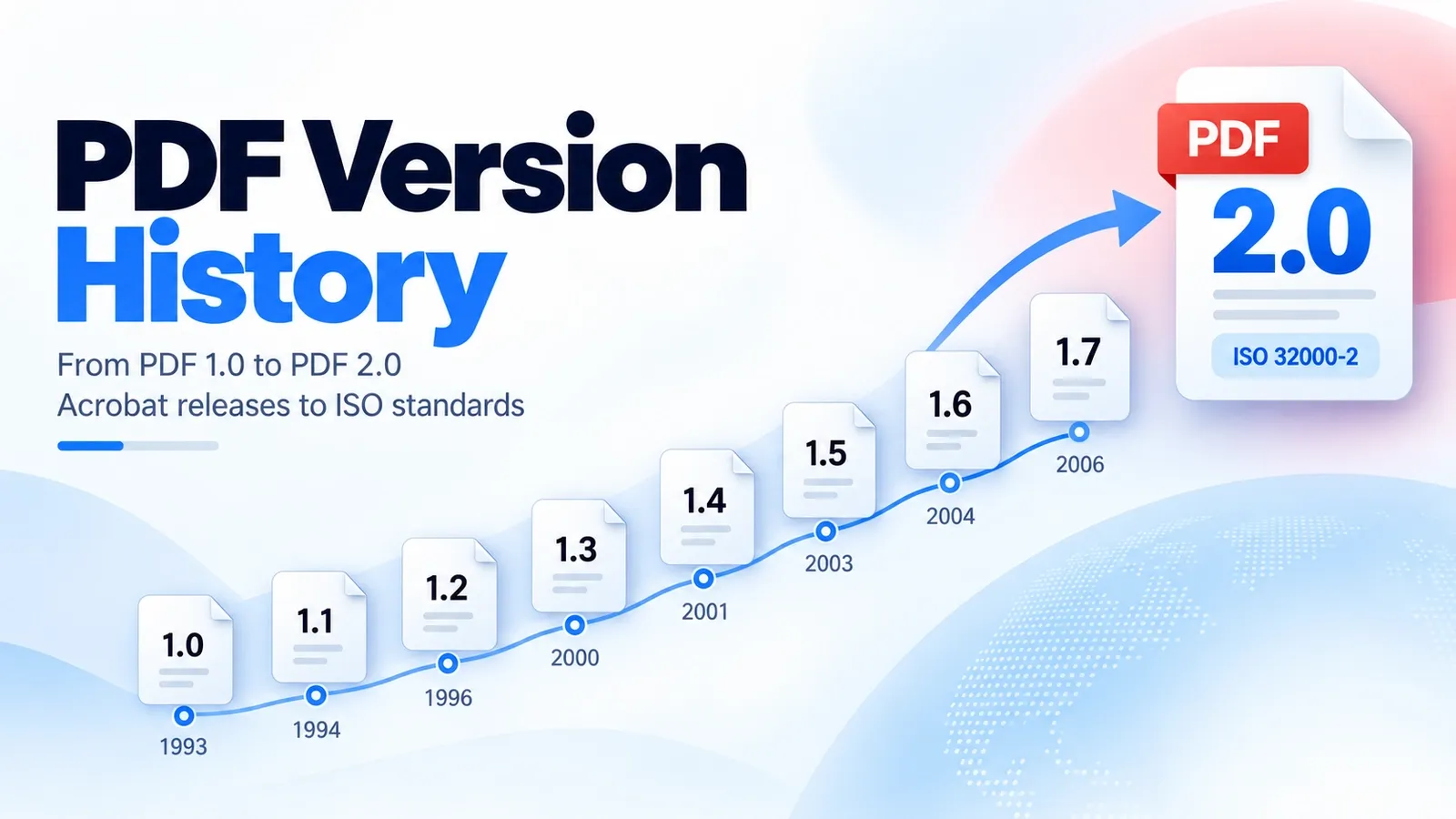
Between 1993 and 2006, Adobe released PDF 1.0 to 1.7, with each major update tied to different Acrobat versions and a new set of practical capabilities. The format moved from a fixed digital page format into a richer document container for forms, accessibility, compression, 3D content, and signatures.
| PDF Version | Acrobat Release | Defining Capability Added |
|---|---|---|
| PDF 1.0 | Acrobat 1.0 | Established the basic fixed-layout page model for viewing and printing consistent digital documents. |
| PDF 1.1 | Acrobat 2.0 | Improved the early document exchange workflow and helped PDF spread with the free Reader model. |
| PDF 1.2 | Acrobat 3.0 | Added stronger interactive document support, including AcroForm form fields. |
| PDF 1.3 | Acrobat 4.0 | Improved publishing support with better color handling and CID font support for larger character sets. |
| PDF 1.4 | Acrobat 5.0 | Added live transparency and Tagged PDF, which helped with structured content and accessibility. |
| PDF 1.5 | Acrobat 6.0 | Added object streams and JPEG 2000 support, improving compression and image handling. |
| PDF 1.6 | Acrobat 7.0 | Added richer engineering and review features, including 3D annotations and stronger digital signatures. |
| PDF 1.7 | Acrobat 8.0 | Consolidated the format before PDF 1.7 was handed to ISO and became the base for ISO 32000-1. |
This version path shows why PDF became more than a static page snapshot. Each release solved a new document problem: filling forms, preserving complex fonts and color, supporting accessible structure, reducing file overhead, adding reviewable 3D content, and protecting documents with stronger signatures.
When Did PDF Become the ISO 32000 Standard?
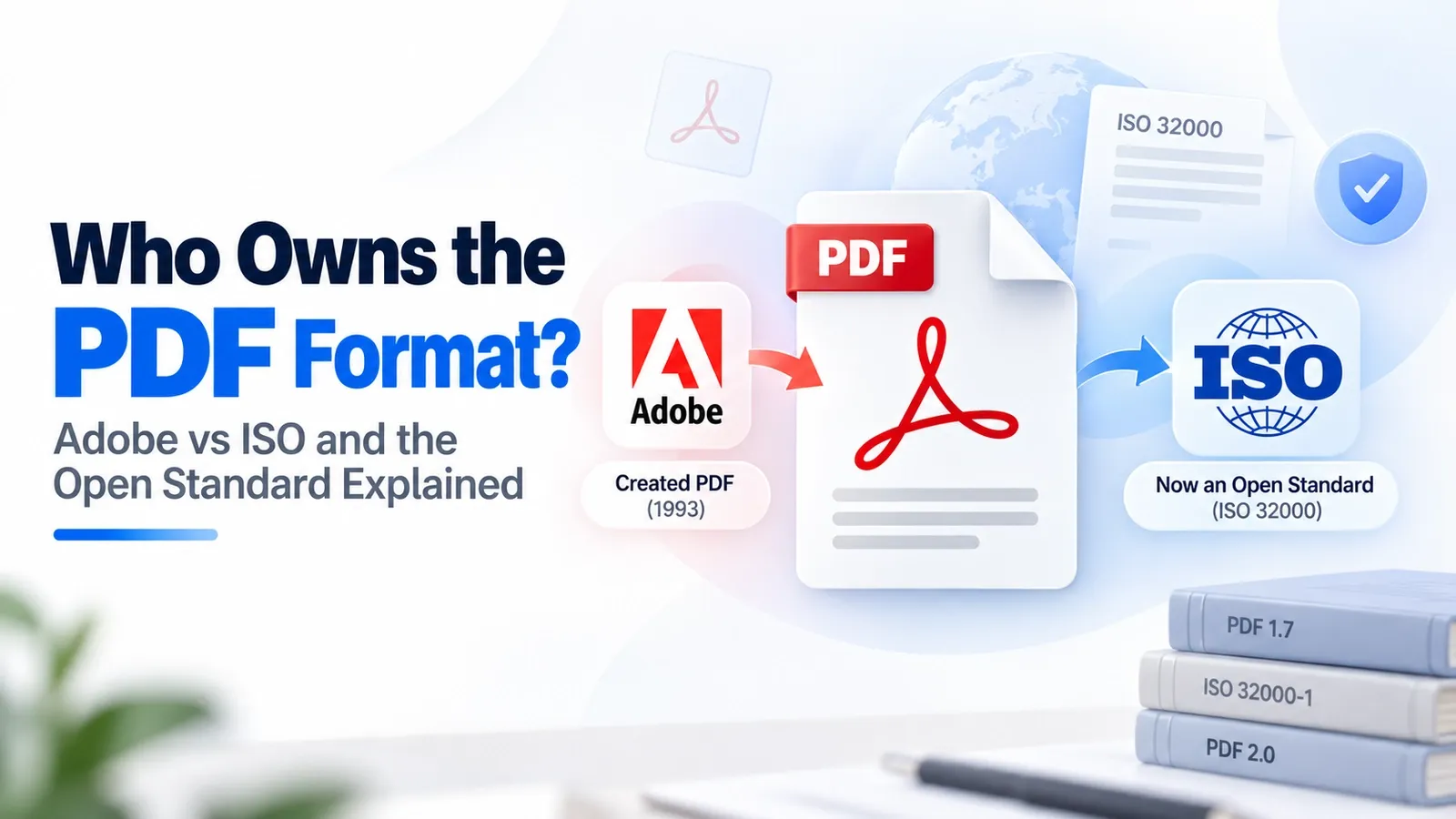
PDF became an ISO standard when Adobe handed PDF 1.7 to the International Organization for Standardization, and the specification was published as ISO 32000-1:2008 on July 1 2008.
Before that handoff, PDF was widely used, but the main specification still came from Adobe’s own development path. Standardization moved PDF away from single-vendor control and turned it into an open standard governed through ISO, specifically through the ISO TC 171 committee structure responsible for document management applications.
That shift changed how the format could evolve. Instead of depending only on Adobe’s product roadmap, PDF updates, clarifications, corrections, and errata could move through an ISO committee process.
For software vendors, governments, businesses, and archives, the long-term value was lower vendor lock-in risk. A standardized PDF could be implemented by different tools under clearer technical rules, which made the format more dependable for preservation, exchange, and long-term access.
What Changed With PDF 2.0 and Why Was It Needed?
PDF 2.0 was published as ISO 32000-2 in 2017, with a 2020 revision that refined the standard further. It was needed because PDF had become too important to depend on older Adobe-era wording, unclear technical rules, or features that were not fully controlled through ISO.
The biggest change was governance and clarity. PDF 2.0 was the first PDF version defined entirely by ISO, with no proprietary features carried over from Adobe’s private control. That made the standard cleaner for software vendors, archives, governments, and anyone building long-term PDF workflows.
PDF 2.0 did not reinvent the format from scratch. Instead, it harmonized terminology and clarified how important parts of the format should work, including fonts, color, transparency, metadata, encryption, and digital signatures.
Another important change is access to the standard itself. The PDF 2.0 specification is now available as a free specification through the PDF Association, which makes it easier for developers and organizations to understand, implement, and validate modern PDF behavior.
Why Did PDF Subsets Like PDF/A, PDF/X, and PDF/UA Emerge?
PDF subsets emerged because different industries needed PDFs to behave in guaranteed ways. ISO defined constrained PDF profiles so a file could meet a specific purpose, such as print production, long-term archiving, accessibility, or engineering exchange.
A subset is not a separate format. It is a profile of PDF with stricter rules for conformance. Those rules limit risky features, require important resources, and make the file more predictable for a specific workflow.
| PDF Subset | ISO Standard | Main Job | What It Guarantees |
|---|---|---|---|
| PDF/X | ISO 15930 | Professional print exchange | A print-focused PDF that carries the required production information and avoids features that can create output problems. |
| PDF/A | ISO 19005 | Long-term archiving | A self-contained archival PDF that keeps required resources, such as fonts and color information, inside the file. |
| PDF/UA | ISO 14289 | Accessibility | A tagged PDF structure that supports assistive technologies, reading order, and accessible document navigation. |
| PDF/E | ISO 24517 | Engineering documents | A technical PDF profile for engineering workflows, including drawings, diagrams, complex visual data, and 3D-related use cases. |
These subsets helped PDF serve specialized industries without changing the base format for everyone. A normal PDF can be flexible, but a conforming subset gives printers, archives, accessibility teams, and engineering workflows clearer rules for what the file must include and what it should avoid.
Why Has PDF Won and Refused to Leave?
PDF outlasted many document formats because it solved the problems that kept coming back: predictable print, cross-platform viewing, self-contained files, long-term readability, room for new features, and, after 2008, open standard governance.
| Durability Factor | Why It Helped PDF Survive |
|---|---|
| Predictable print | A PDF could preserve page size, layout, fonts, images, and spacing more reliably than many editable document formats. |
| Cross-platform support | The same file could open on Windows, Mac, Linux, browsers, mobile devices, and many PDF readers. |
| Self-contained files | Fonts, images, metadata, and page instructions could travel inside the file instead of depending fully on the original app. |
| Longevity | PDF became useful for contracts, manuals, records, research papers, government forms, and archives that needed to stay readable for years. |
| Extensible design | The format kept growing with forms, links, annotations, encryption, signatures, accessibility tags, layers, and rich media. |
| Open standard status | ISO standardization reduced dependence on one company and made PDF safer for long-term software support. |
PDF’s biggest criticism is also part of its strength: the fixed page layout does not naturally adapt like a web page. That can make small-screen reading and accessibility harder when a file is poorly made.
Tagged PDF helped answer that weakness by adding structure behind the fixed page. Tags can define headings, reading order, lists, tables, figures, and form relationships, which supports screen readers and reflow in compatible tools.
That balance explains why PDF still matters in the 2020s. It can act as a final signed document, an archival record, a print-ready file, and a structured source for search, extraction, and AI workflows when the text and tags are created properly.
How Did PDF Move From Proprietary to Open Standard?
PDF began as a proprietary format controlled by Adobe. Before the handoff, Adobe decided how the specification developed, which features were added, and how new versions of the format were defined.
That changed in 2008 when PDF 1.7 became ISO 32000-1. From that point, changes to the core specification moved through an ISO committee rather than depending only on Adobe’s product roadmap. Technical corrections and published errata also became part of the formal standards process.
The PDF Association supports the wider ecosystem by helping software vendors and industry groups understand, implement, and improve PDF interoperability. This shift turned PDF into an open standard with license-free implementation, allowing developers to build PDF readers, writers, validators, and workflow tools without paying Adobe to support the format.
Who Owns the PDF Format Now?
The PDF format has no single owner today. It is an open standard controlled through ISO, which means the core format is not privately owned by one company.
The important distinction is between PDF and Acrobat. Adobe created PDF and still owns Acrobat as a product, including the Acrobat trademark, but Adobe does not own the PDF format itself.
That matters for implementation. Software developers can build PDF readers, writers, validators, and workflow tools in a license-free way for the format itself, without paying royalties just because they support PDF.
For a deeper breakdown of who owns the PDF format, the ownership question comes down to three roles. ISO controls the standard, the PDF Association supports industry stewardship, and Adobe owns Acrobat as a branded product.
How Has the PDF Version History Changed?
PDF version history moved from Adobe-numbered releases to ISO-governed editions. The path runs from PDF 1.0 to 1.7, released between 1993 and 2006 with an Acrobat mapping, then into PDF 2.0 as the modern ISO-defined version.
| Era | Version Timeline | What Changed |
|---|---|---|
| Adobe release era | PDF 1.0 in 1993 through PDF 1.7 in 2006 | Each version followed Acrobat releases and added features such as forms, transparency, Tagged PDF, object streams, 3D support, and stronger signatures. |
| First ISO standard era | ISO 32000-1 in 2008 | PDF 1.7 became the base ISO standard, moving the format away from Adobe-only control. |
| PDF 2.0 era | ISO 32000-2 in 2017, revised in 2020 | PDF 2.0 became the fully ISO-defined edition, focused on clearer rules, terminology, security, signatures, metadata, and interoperability. |
This version timeline shows the main arc without repeating every technical detail: Adobe built the early versions, ISO standardized PDF 1.7, and PDF 2.0 refined the format under international standards governance.
For the full version-by-version breakdown, see the dedicated PDF version history guide, which can cover each release in more depth without overloading this history article.
Is PDF/A a Separate Format?
PDF/A is not a separate format; it is a constrained PDF profile defined by ISO 19005 for long-term archiving.
The confusion happens because PDF/A has stricter rules than a normal PDF and may be labeled separately by PDF tools. Even so, a PDF/A file is still a PDF and can open in a normal PDF reader.
PDF/A is built for future readability, so it requires important resources such as embedded fonts and document information to stay inside a self-contained file. It also restricts features that can break long-term access, such as external dependencies, scripts, and encryption.
The key idea is profile not format: PDF/A is a PDF that must meet a specific conformance level. For a clearer comparison with print and accessibility profiles, see the full guide on PDF/A vs PDF/X vs PDF/UA.